
Case Study
Machine learning based clustering algorithms in E-commerce for reducing operating cost of reverse logistics up to 20%
Platforms – Data Analytics
Introduction:
Reverse logistics, an important part of the process of managing the supply chain for e-commerce businesses, has become much more important in recent years. With the rise of online shopping, the number of returns, swaps, and refunds has reached levels that have never been seen before. In 2021, the value of the global reverse transportation market was US$ 563.2 Billion. The market is expected to reach US$ 812.6 Billion by 2027, with a CAGR of 5.80% between 2022 and 2027. Managing these processes well has become a must for e-commerce companies that want to make sure their customers are happy and save money.

This case study is a powerful look at how an e-commerce company can optimize its reverse operations, including the many problems they faced, the answers they came up with, and the results they got. Through this case study, we will explain why optimized reverse logistics are so important in the e-commerce business and how they can lead to a more efficient and sustainable supply chain.
Problem Statement
To optimize reverse logistics in e-commerce by improving the route and clustering similar groups together.
Expected outcomes:–
- Cost Reduction: By managing reverse logistics effectively, cost can be reduced up to 20 %.
- Improved Efficiency: Operations will be streamlined, which will decrease order processing time by 15%.
- Customer Satisfaction: By providing hassle-free and seamless returns experiences, e-commerce businesses can improve customer satisfaction and build brand loyalty.
- Sustainability: Effective management of reverse logistics can help e-commerce businesses reduce their carbon footprint and contribute towards sustainability goals..
Dataset: –
These following data points can be considered to optimize the reverse logistics process.
| Sr.no | Data variable | Source |
| 1 | Service, transit time | IOT |
| 2 | Number of stops, nearest warehouse distance | Market research |
| 3 | Total route time and delays | IOT-vehicle tracking IOT |
| 4 | Number of forward and backward deliveries | ERP-sales module |
| 5 | Fuel cost, vehicle cost | Market research |
| 6 | Reason for return | ERP-Product module |
| 7 | Mode of transport | ERP-delivery module |
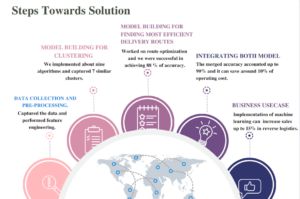
- Initial step is capturing data points that are essential for model building post that we cleaned the dataset and performed feature engineering.
- We aimed to cluster similar locations together wherein we have similar return order requests and as well as new order requests.
- For clustering, we used different techniques such as hierarchical clustering, DBscan, Grid based, K-nearest Neighbor which resulted in identification of 7 clusters.
- We developed a route optimization model using TSP algorithm, furthermore we integrated both the model for identifying the best route possible for a delivery agent to collect the return order along with delivering new orders.
Dashboard for COO:-
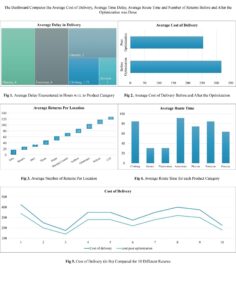 Inferences:-
Post optimization, there was a significant cost reduction of 20%.
Different locations are clubbed together post clustering,47% of return was accounted for in the clothing industry.
Impacts:-
Long-term business impact:
Increased customer loyalty: Implementing efficient reverse logistics processes can enhance customer satisfaction and loyalty. Customers who experience hassle-free returns or exchanges are more likely to become repeat customers and recommend the business to others, leading to long-term revenue growth.
Positive brand reputation: A well-managed reverse logistics system demonstrates a commitment to customer service and can enhance the brand reputation. Word-of-mouth recommendations from satisfied customers can attract new customers and create a positive image for the business in the long run.
Competitive advantage: By investing in AI models and optimizing reverse logistics, businesses can gain a competitive edge over their competitors. Streamlined returns processes and better inventory management can differentiate the business from others in the market, attracting more customers and potentially increasing market share.
Short-term business impact:
Increased sales and revenue: Implementing efficient reverse logistics can have an immediate impact on sales. Faster processing of returns leads to quicker refunds or exchanges, encouraging customers to make additional purchases. This can result in an immediate boost in sales and revenue.
Cost savings: Optimized reverse logistics can lead to better inventory management, reducing the costs associated with excess inventory and obsolete products. In the short term, businesses can benefit from cost savings by reducing the amount of tied-up capital in inventory and minimizing write-offs.
Improved customer satisfaction: A streamlined and efficient returns process improves customer satisfaction in the short term. When customers have a positive experience with returning products, they are more likely to have confidence in future purchases, leading to repeat business and positive word-of-mouth recommendations.
Conclusion:-
To sum up, it is clear that optimizing reverse logistics is a must for e-commerce companies that want to improve their bottom line, increase operational efficiency, improve customer happiness, and make their business more sustainable. This case study shows how machine learning-based grouping methods can be used to reduce the running costs of reverse shipping by up to 20%. When a TSP method for route optimisation was combined with a grouping model, the cost went down by a huge 20%. Also, optimizing backward transportation can boost sales and make it easier to keep track of goods.