
Case Study
Revolutionizing the Restaurant Industry: Machine Learning-based Demand Forecasting boosts profits by 15%”
Industries- Manufacturing
Introduction
The restaurant industry, an esteemed and highly competitive business sector, comprises a wide array of establishments committed to delivering exquisite culinary offerings, crafting exceptional dining experiences, and catering to the ever-evolving palate of discerning customers. Accurately anticipating product and service demand is essential to success in this industry..Annually, the restaurant industry loses $162 billions due to inaccurate demand forecasting. Estimations of demand improve operations, recruitment, and product management, thereby increasing sales and profitability. This case study will illustrate how machine learning can improve the operations and profitability of restaurants.A restaurant chain employs machine learning to enhance demand forecasting and increase revenue by 15%. In this case study we will investigate the restaurant chain’s issues, data capture and analysis, machine learning techniques, and results and also demonstrate how competing food companies can utilize this technology.
Problem Statement:
To Predict accurate demand, aiming to minimize inventory costs and optimize resource allocation processes. Various factors such as seasonality, external influences, menu offerings, promotional activities, market competition etc. contribute to this problem. The demand forecasting accuracy can be improved by deploying machine learning.
Expected Outcomes:
- Inventory management: Accurate demand forecasting can aid restaurant chains in inventory management by reducing waste by up to 10 percent resulting in a cost savings of $2 million.
- Staffing:By anticipating peak periods of high demand, restaurants can proactively allocate adequate staff resources to minimize waiting times and effectively cater to customer needs
- Sales and revenue: Demand forecasting can help boost sales by 15% resulting in an increase in revenue of $8.5 million.
Data Required:
This table provides an overview of various data points required for model building. The ERP system’s CRM module handles customer-related data such as age, gender while the promotion and sales data is obtained from Sales and marketing module of ERP
| S.no | Data Points | Source |
| 1 | Date | Market research companies – Nielsen india, Ipsos |
| 2 | Days of the week | Market research companies – Nielsen india, Ipsos |
| 3 | Festival days and details | Government websites – Ministry of Culture,Ministry of Tourism |
| 4 | Weather condition | Weather data providers – Weather API, Meteosat |
| 5 | Promotion |
Sales and marketing module of ERP
|
| 6 | Sales |
Sales and marketing module of ERP
|
| 7 | Customer rating | Customer relationship management module of ERP |
| 8 | Most ordered Items |
Sales and marketing module of ERP
|
| 9 | Consumer demographics such as age,gender etc, | Customer relationship management module of ERP |
| 10 | Customer review about hotel | Websites and apps on which the hotel is listed – Goibibo, Booking.com ,MakeMyTrip and Customer relationship management module of ERP |
Steps towards solution
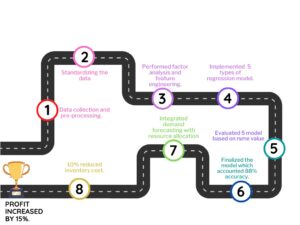
- The data gathering process included treating null values and outliers, and subsequent normalization of the data was performed to ensure equal impact from each variable.
- Feature engineering techniques, specifically factor analysis aided by scree plots, were employed to identify the variable influencing demand.
- Multiple machine learning algorithms, such as multiple regression, linear regression, and random forest regressor, were applied to develop the predictive models.
- Hyperparameter optimization was conducted to enhance the efficacy of the models, and it was determined that the gradient boosting algorithm achieved an accuracy of approximately 88%.
- Correlation analysis was performed on various demand-related variables to gain insights into consumer behavior.
- The implementation of the predictive model resulted in a predicted 10% reduction in inventory costs, which was realized, leading to a subsequent 15% increase in overall profit.
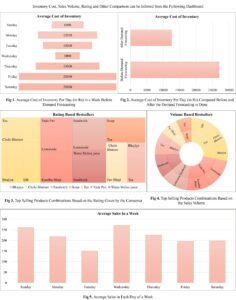
Dashboard for Chief Operating Officer:
Impact on business
- Using data-driven prediction methods, businesses can anticipate a 5–15% increase in revenue resulting in an increased of revenue of $10 million.
- Demand planning can also reduce food waste by an astounding 10–20%, which saves around $5 million and has a reduced overall impact on the environment.
- Forecasting can also aid in optimizing personnel, which can reduce labor costs by 5–10% saving $1.8 million.
- The cost of implementing a machine learning demand forecasting system in a restaurant could range from 0.5 to 1% of profit, depending on the project. However, increased demand forecasting may eventually result in an increase in income that outweighs expenses.
Conclusion
In conclusion, this case study showcases the immense potential of machine learning in revolutionizing the restaurant industry and highlights the crucial role of data-driven decision making. By leveraging the power of accurate demand prediction, restaurants can effectively manage inventory, optimize personnel allocation, and achieve remarkable sales growth of up to 15%. Through the utilization of machine learning algorithms built on GroundZero Unified Data Platform and fine-tuning hyperparameters, it becomes feasible to develop highly accurate and efficient models. Embracing these technologies paves the way for enhanced operational efficiency and improved business outcomes in the dynamic and competitive restaurant landscape.